3D modelling and rendering: timelines and complexity
WHY ARE SOME 3D PROJECTS MORE COMPLEX THAN OTHERS?
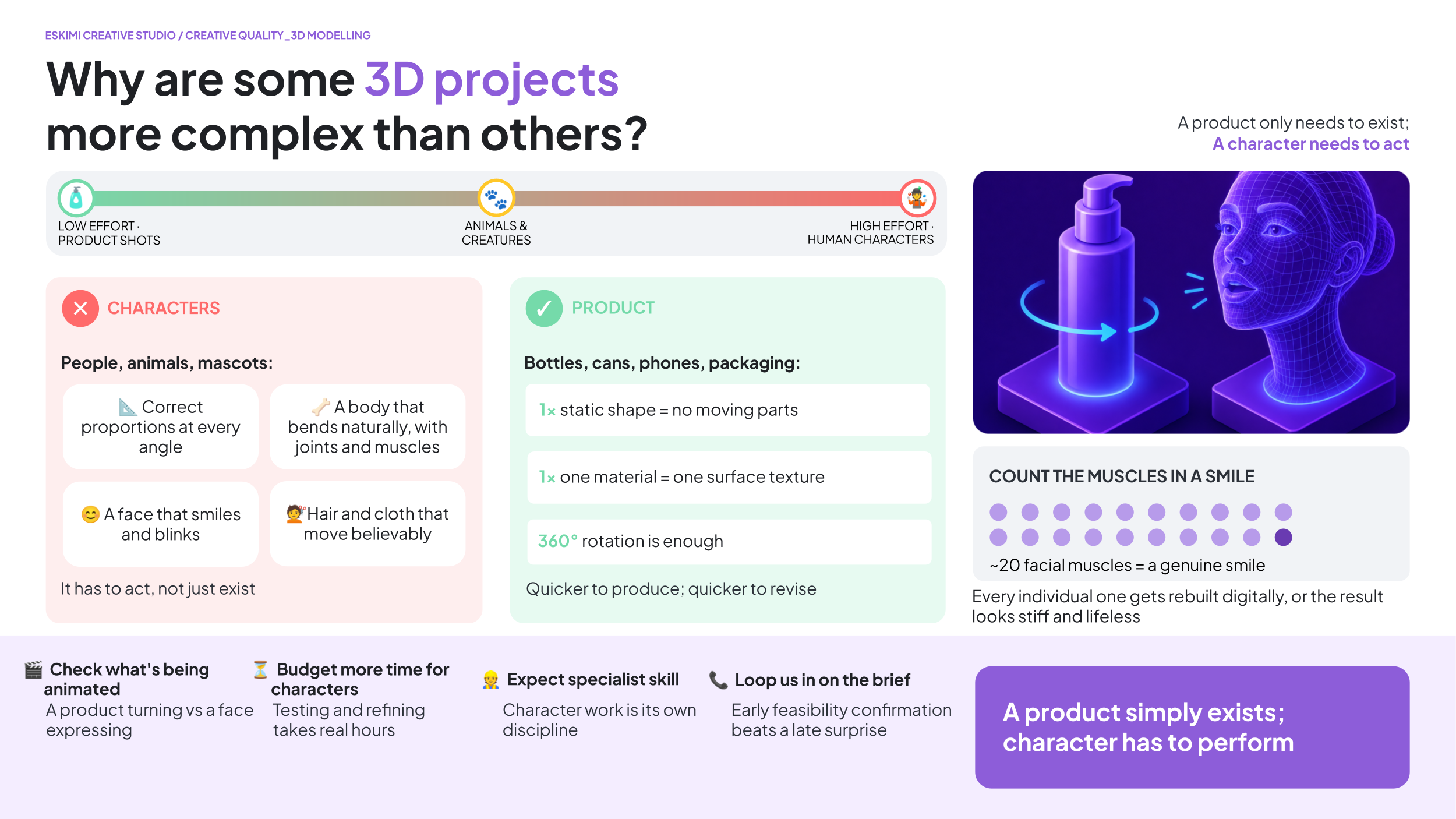
Not all 3D projects require the same level of effort.
Simple product animations (such as rotating bottles, cans, phones, or packaging) are generally quicker to produce than people, animals, or characters.
Characters are significantly more complex because they require:
-
Build the entire character in 3D, with correct proportions from all angles
-
Make the body bend and move naturally
-
Make the face smile, blink, and show expressions
-
Make hair and clothing move realistically with believable textures
-
Animate everything so it looks believable
-
Spend much more time testing and refining the final result
Think about how many tiny muscles in your face move when you smile, laugh, frown, blink, or talk. A 3D artist has to recreate all of those movements digitally so the character looks natural rather than stiff or lifeless. A product only needs to exist. A character needs to act. It has to move, express emotion, and behave.
As a result, character-based 3D projects typically require more specialist skills, longer timelines, and larger budgets than product visualisation.
If a brief involves animated people, animals, or characters, please involve Creative Studio early so we can advise on feasibility, timelines, and production requirements before commitments are made.
WHY ARE 3D ANIMATION SO MUCH MORE COMPLEX TO BUILD AND CHANGE?
Unlike a flat design, a 3D scene is a complete virtual environment. Changing the position of an object often means reworking:
-
Camera angles
-
Lighting
-
Shadows
-
Reflections
-
Object animations
-
The overall composition
What looks like a small change can require rebuilding part of the scene so everything still looks natural.
WHY DO SOME 3D REVISIONS TAKE SO LONG?
Not all revisions are equal. Changing text or colours may be relatively quick.
However, changing how objects move, interact, or appear in the scene often means rebuilding and reanimating parts of the project rather than simply editing what already exists.
The more movement involved, the more work is usually required.
WHY CAN'T YOU JUST SPLIT UP OR DIVIDE THE 3D MODEL?
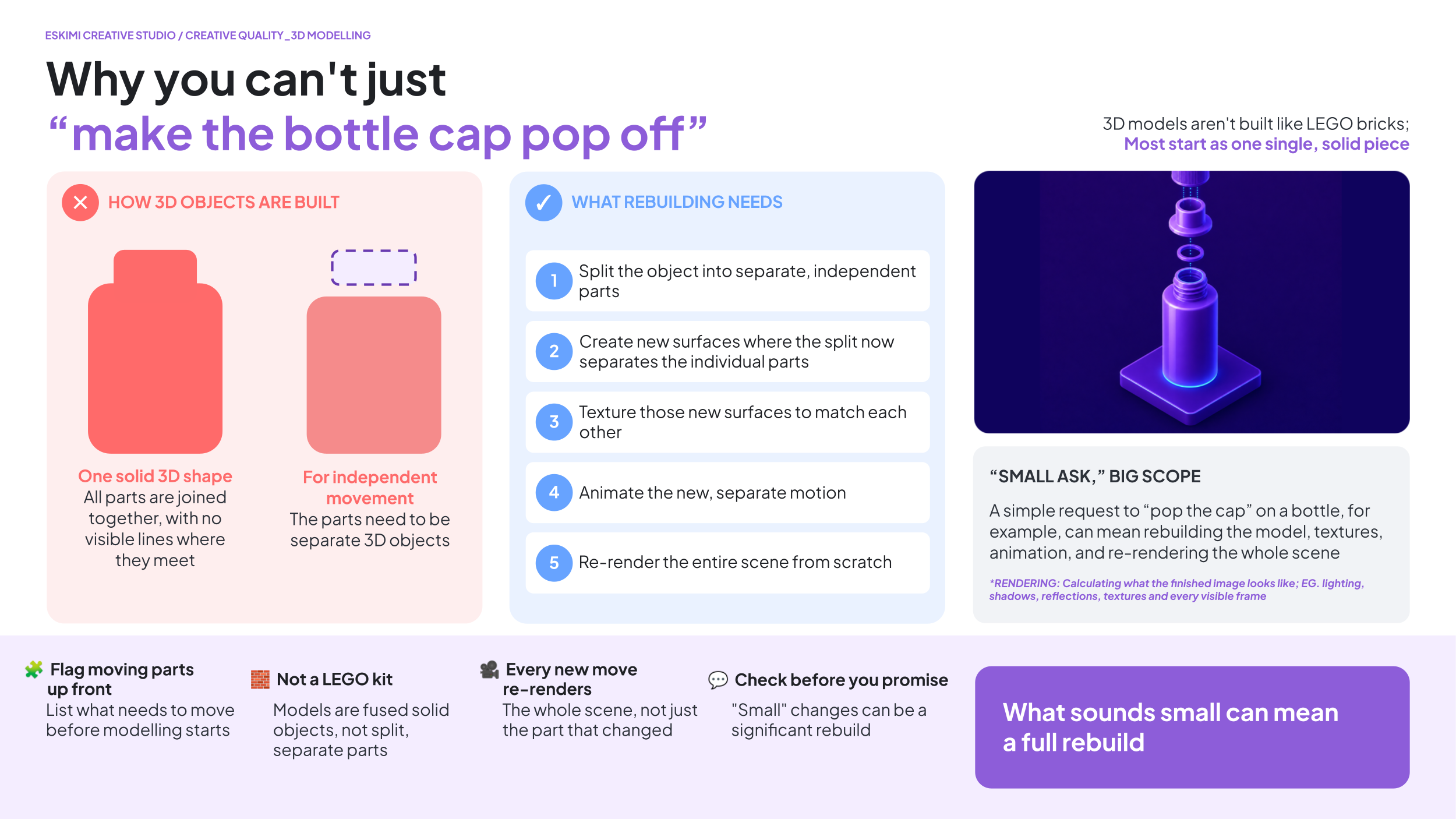
3D models aren't built like LEGO bricks.
Many models are created as a single object. If a client later wants part of that object to move independently (such as a bottle cap opening), we first need to rebuild the model into separate moving parts.
That may involve:
-
Rebuilding the model
-
Creating new surfaces and textures
-
Creating new animations
-
Re-rendering the entire scene
What sounds like a small change can sometimes become a significant rebuild.
WHY DO WATER, SMOKE, FIRE AND OTHER EFFECTS TAKE SO LONG?
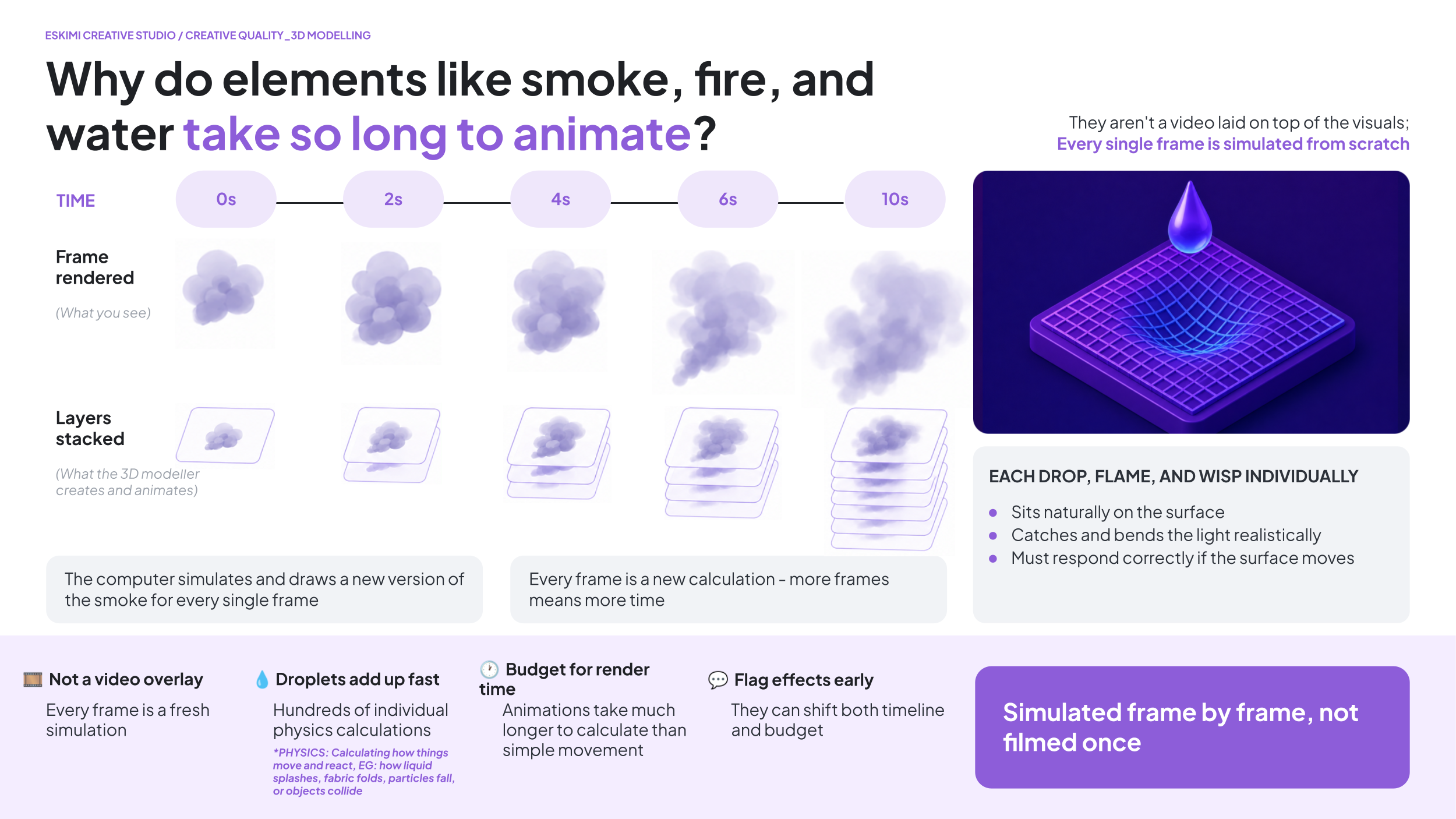
Effects like water, steam, smoke, bubbles, splashes and fire aren't simply videos placed on top of an animation. The computer calculates how these effects move through the scene, frame by frame.
Think of it like drawing a puff of smoke...
...then drawing it again...
...and again...
...for every single frame of a 10-second animation.
That's why these effects require considerably more processing time than simple object animation.
WHY DO WATER DROPS TAKE SO LONG?
A wet bottle isn't just a bottle with dots on it. Each individual droplet has to:
-
Sit naturally on the curved surface
-
Catch the light correctly
-
Reflect its surroundings
-
Look realistic from every viewing angle
-
Move naturally as the object rotate
A single bottle can contain hundreds of droplets, each of which the computer must calculate separately.
WHY DOES RENDERING TAKE SO LONG?
Finishing the animation doesn't mean it's ready immediately. Once all changes are complete, the computer still needs to calculate every frame of the final animation.
Think of it like baking a cake. Mixing the ingredients doesn't make the cake ready - you still have to bake it. Rendering is that baking stage.
For every frame, the computer calculates:
-
Lighting
-
Shadows
-
Reflections
-
Transparency
-
Materials
-
Visual effects
A short animation may contain hundreds of frames, so rendering alone can take several hours.
WHY CAN'T RENDERING BE MADE FASTER?
Rendering is performed by the computer, rather than the artist. Once rendering begins, the computer must calculate every frame individually.
While we always optimise our scenes where possible, rendering time is largely determined by the complexity of the animation and cannot simply be sped up without reducing quality.
WHY DO MULTIPLE REVISION ROUNDS TAKE SO LONG IN 3D?
Unlike a presentation or Photoshop file, a 3D scene is built as one complete environment where everything works together.
Changing one element often affects many others. For example, moving an object may also require updates to:
-
Camera angles
-
Lighting
-
Shadows
-
Reflections
-
Animations
-
Scene composition
Once those changes are complete, the entire animation usually needs to be rendered again before a new preview can be shared.
For this reason, repeated revision rounds can have a significant impact on delivery timelines.
Think of it like building a house. It's much easier to decide where the windows go before the walls are built than to move them after the house is finished.
To keep projects moving efficiently, we ask clients to review versions carefully and provide one consolidated round of feedback wherever possible.
WHY ARE 3D PROJECTS MORE EXPENSIVE?
3D animation is a specialist craft. Projects often involve:
-
3D modelling
-
Texturing
-
Lighting
-
Animation
-
Visual effects
-
Rendering
-
Multiple rounds of testing and quality assurance
Complex animations can take many days to produce, which is why 3D projects typically have higher production costs and minimum media investments than standard banner production.
WHY CAN'T AI JUST DO THE 3D WORK FASTER?
AI is an incredibly useful creative tool, but it isn't yet capable of replacing professional 3D production for most commercial advertising.
While AI can often generate an impressive-looking image or short video, it currently struggles with the things we need for real advertising campaigns, such as:
-
Creating consistent results across multiple scenes
-
Producing editable assets that can be revised later
-
Making changes based on client feedback
-
Recreating the same animation across multiple banner sizes and formats
-
Maintaining accurate branding, products, and fine details
Advertising rarely ends with the first version. Clients often request copy changes, logo updates, different languages, new products, or revised animations. To make those changes, we need editable project files rather than a finished AI-generated video.
Like our cake analogy, think of it like asking AI to bake a cake. It might produce something that looks great in a photo, but if the client later asks for less sugar, a different flavour, or a larger cake, it's much easier if you still have the recipe than if all you have is the finished cake.
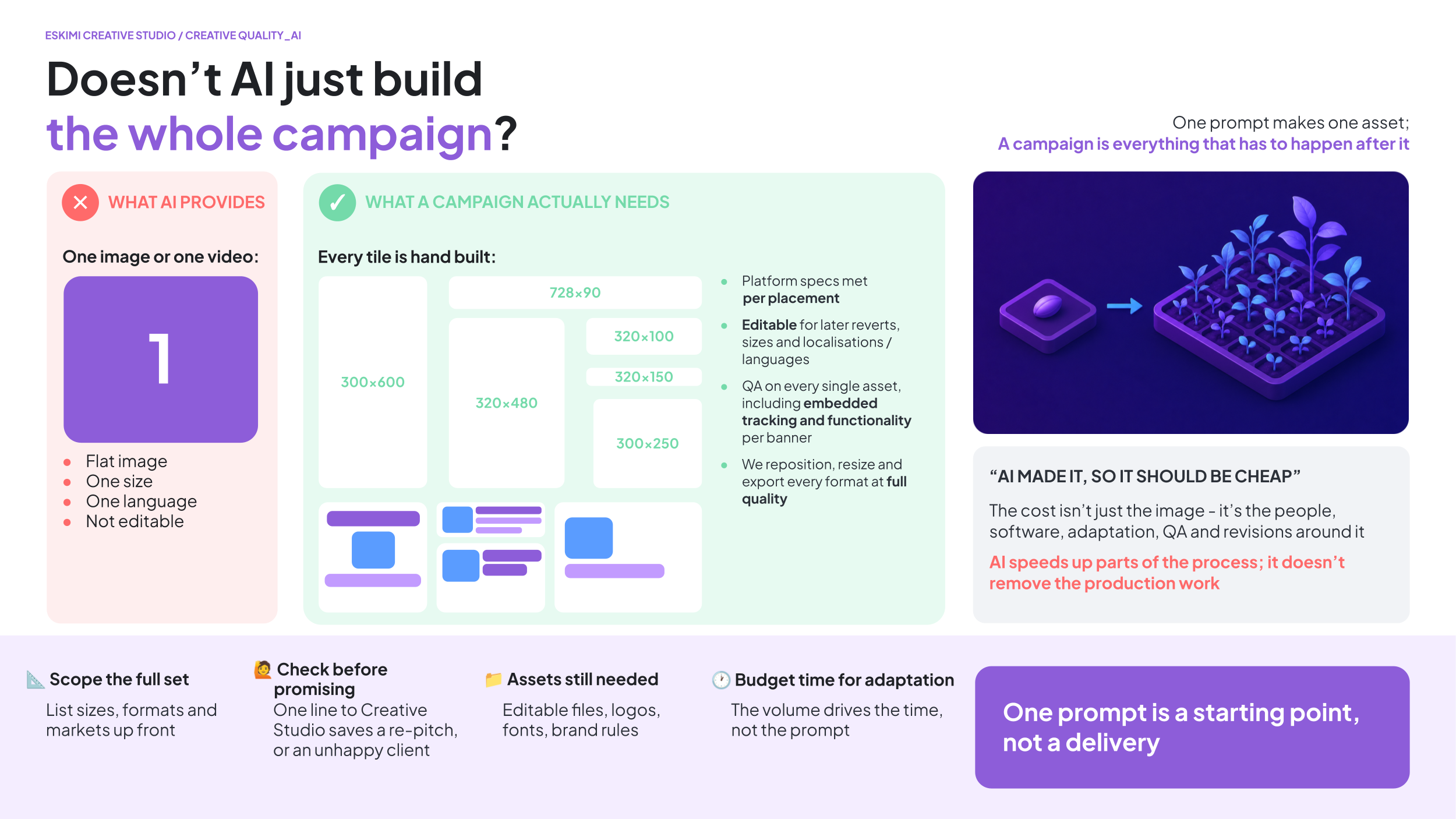
AI is already helping us speed up parts of our workflow where appropriate, and we continue to evaluate new tools as they mature. However, for high-quality, editable, production-ready advertising, skilled artists and traditional 3D workflows are still essential.