3D modelling and rendering: timelines and complexity
QUICK ANSWER
3D modelling and animation can produce incredibly engaging creative experiences, but they involve more complex production processes than standard design or animation.
This guide explains why some 3D projects take longer than others, what affects production timelines and costs, and why certain technical processes cannot simply be accelerated - even for urgent campaigns.
Standard lead time: Allow up to 7 working days from receipt of all required assets, information and clarifications. Actual timelines depend on the complexity of the execution.
Need more detail? Read the explanations below👇
⏱️ HOW LONG DOES 3D PRODUCTION TAKE?
HOW LONG DOES 3D PRODUCTION TAKE?
3D modelling and animation require up to 7 working days, starting from the point when Creative Studio has received all required assets, information and clarifications needed to begin production.
This lead time reflects the technical work involved, including modelling, animation, simulations, rendering and quality checks.
Important: The production timeline does not necessarily begin when a brief is submitted. Missing assets, incomplete information or outstanding clarifications can delay the start of production.
💰 WHY ARE 3D PROJECTS MORE EXPENSIVE?
WHY ARE 3D PROJECTS MORE EXPENSIVE?
3D animation is a specialist craft. Projects often involve:
-
3D modelling
-
Texturing
-
Lighting
-
Animation
-
Visual effects
-
Rendering
-
Multiple rounds of testing and quality assurance
Complex animations can take many days to produce, which is why 3D projects typically have higher production costs and minimum media investments than standard banner production.
🏎️ WHY CAN'T URGENT 3D PROJECTS SIMPLY BE COMPLETED FASTER?
WHY CAN'T URGENT 3D PROJECTS SIMPLY BE COMPLETED FASTER?
We understand that some campaigns are commercially important, time-sensitive or linked to significant client opportunities. Creative Studio will always aim to support these priorities wherever possible.
However, commercial urgency does not reduce the technical complexity of 3D production.
Unlike traditional design work, many stages of 3D production rely on computational processes that cannot simply be accelerated by working faster or assigning more people.
For example:
-
Modelling: Complex objects must be constructed and prepared before they can be animated.
-
Animation: Movement, lighting, materials and interactions must be configured and tested.
-
Simulations: Effects such as water, smoke and fire require mathematical calculations to behave realistically.
-
Rendering: Software must calculate each frame, including lighting, shadows, reflections and movement. A final render alone can take several hours.
-
Revisions: Changes may require animations, simulations or rendered sequences to be recalculated.
Some tasks can be prioritised or performed in parallel, but others must happen in sequence. Adding more people or requesting a faster turnaround does not necessarily shorten these processes.
WHAT DOES THIS MEAN FOR CAMPAIGN PLANNING?
For technically complex formats, it's important to involve Creative Studio early and plan campaign launch dates around the communicated production lead times.
We can assess opportunities to simplify an execution or reduce its complexity when shorter timelines are required, but this may mean adjusting the creative concept or scope.
The key takeaway: Priority determines when we focus our resources on a project. It cannot eliminate the technical steps required to produce it.
Planning a 3D campaign? Allow up to 7 working days from receipt of all required assets and clarifications. Urgent commercial deadlines do not automatically shorten technical production times. Please involve Creative Studio early if your campaign has a fixed launch date.
⏳ WHY DOES RENDERING TAKE SO LONG?
WHY DOES RENDERING TAKE SO LONG?
Finishing the animation doesn't mean it's ready immediately. Once all changes are complete, the computer still needs to calculate every frame of the final animation.
Even once the modelling and design are complete, the final rendering process alone can take up to 8 hours. This is a computational process where the software calculates movement, lighting, shadows, reflections, etc. It's not something the producer can simply work faster to complete, regardless of the urgency or commercial value of the campaign.
Think of it like baking a cake. Mixing the ingredients doesn't make the cake ready - you still have to bake it. Rendering is that baking stage. For every frame, the computer calculates:
-
Lighting
-
Shadows
-
Reflections
-
Transparency
-
Materials
-
Visual effects
A short animation may contain hundreds of frames, so rendering alone can take several hours.
WHY CAN'T RENDERING BE MADE FASTER?
Rendering is performed by the computer, rather than the artist. Once rendering begins, the computer must calculate every frame individually.
While we always optimise our scenes where possible, rendering time is largely determined by the complexity of the animation and cannot simply be sped up without reducing quality.
Rendering is computationally intensive → the software needs time to process → commercial urgency cannot override that processing time.
🧮 WHY DO MULTIPLE REVISION ROUNDS TAKE LONGER IN 3D?
WHY DO MULTIPLE REVISION ROUNDS TAKE LONGER IN 3D?
Unlike a presentation or Photoshop file, a 3D scene is built as one complete environment where everything works together.
Changing one element often affects many others. For example, moving an object may also require updates to:
-
Camera angles
-
Lighting
-
Shadows
-
Reflections
-
Animations
-
Scene composition
Once those changes are complete, the entire animation usually needs to be rendered again before a new preview can be shared.
For this reason, repeated revision rounds can have a significant impact on delivery timelines.
Think of it like building a house. It's much easier to decide where the windows go before the walls are built than to move them after the house is finished.
To keep projects moving efficiently, we ask clients to review versions carefully and provide one consolidated round of feedback wherever possible.
🧩 WHY ARE SOME 3D PROJECTS & REVISIONS MORE COMPLEX?
WHY ARE SOME 3D PROJECTS MORE COMPLEX THAN OTHERS?
Not all 3D projects require the same level of effort.
Simple product animations (such as rotating bottles, cans, phones, or packaging) are generally quicker to produce than people, animals, or characters.
Characters are significantly more complex because they require:
-
Build the entire character in 3D, with correct proportions from all angles
-
Make the body bend and move naturally
-
Make the face smile, blink, and show expressions
-
Make hair and clothing move realistically with believable textures
-
Animate everything so it looks believable
-
Spend much more time testing and refining the final result
Think about how many tiny muscles in your face move when you smile, laugh, frown, blink, or talk. A 3D artist has to recreate all of those movements digitally so the character looks natural rather than stiff or lifeless. A product only needs to exist. A character needs to act. It has to move, express emotion, and behave.
As a result, character-based 3D projects typically require more specialist skills, longer timelines, and larger budgets than product visualisation.
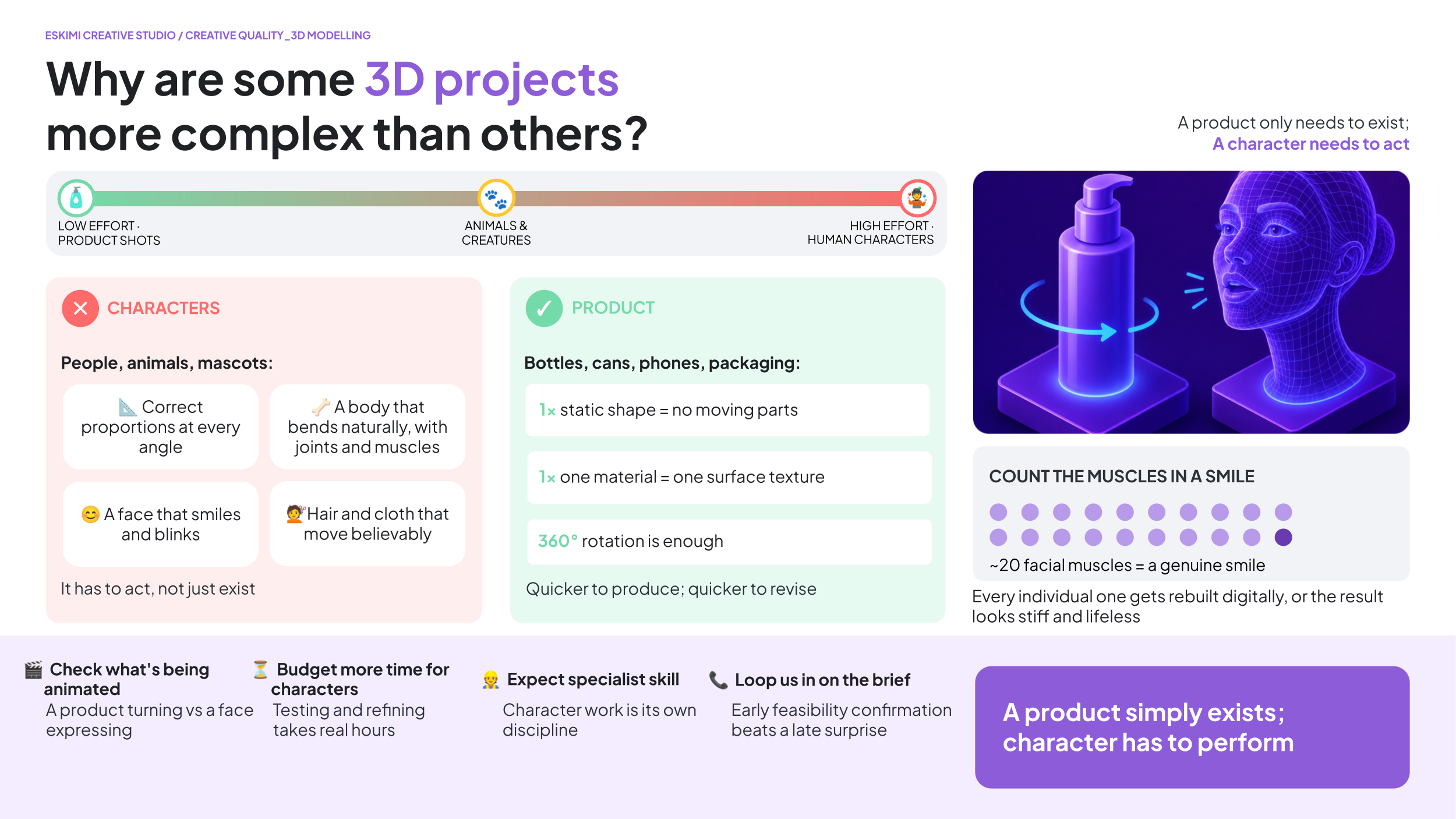
If a brief involves animated people, animals, or characters, please involve Creative Studio early so we can advise on feasibility, timelines, and production requirements before commitments are made.
WHY ARE 3D ANIMATION SO MUCH MORE COMPLEX TO BUILD AND CHANGE?
Unlike a flat design, a 3D scene is a complete virtual environment. Changing the position of an object often means reworking:
-
Camera angles
-
Lighting
-
Shadows
-
Reflections
-
Object animations
-
The overall composition
What looks like a small change can require rebuilding part of the scene so everything still looks natural.
WHY DO SOMEMULTIPLE 3D REVISIONSREVISION ROUNDS TAKE SO LONG?
Not all revisions are equal. Changing text or colours may be relatively quick.
However, changing how objects move, interact, or appear in the scene often means rebuilding and reanimating parts of the project rather than simply editing what already exists.
The more movement involved, the more work is usually required.
🔪 WHY CAN'T YOU JUST SPLIT UP OR DIVIDE THE 3D MODEL?
WHY CAN'T YOU JUST SPLIT UP OR DIVIDE THE 3D MODEL?
🔪 WHY CAN'T YOU JUST SPLIT UP OR DIVIDE THE 3D MODEL?
WHY CAN'T YOU JUST SPLIT UP OR DIVIDE THE 3D MODEL?
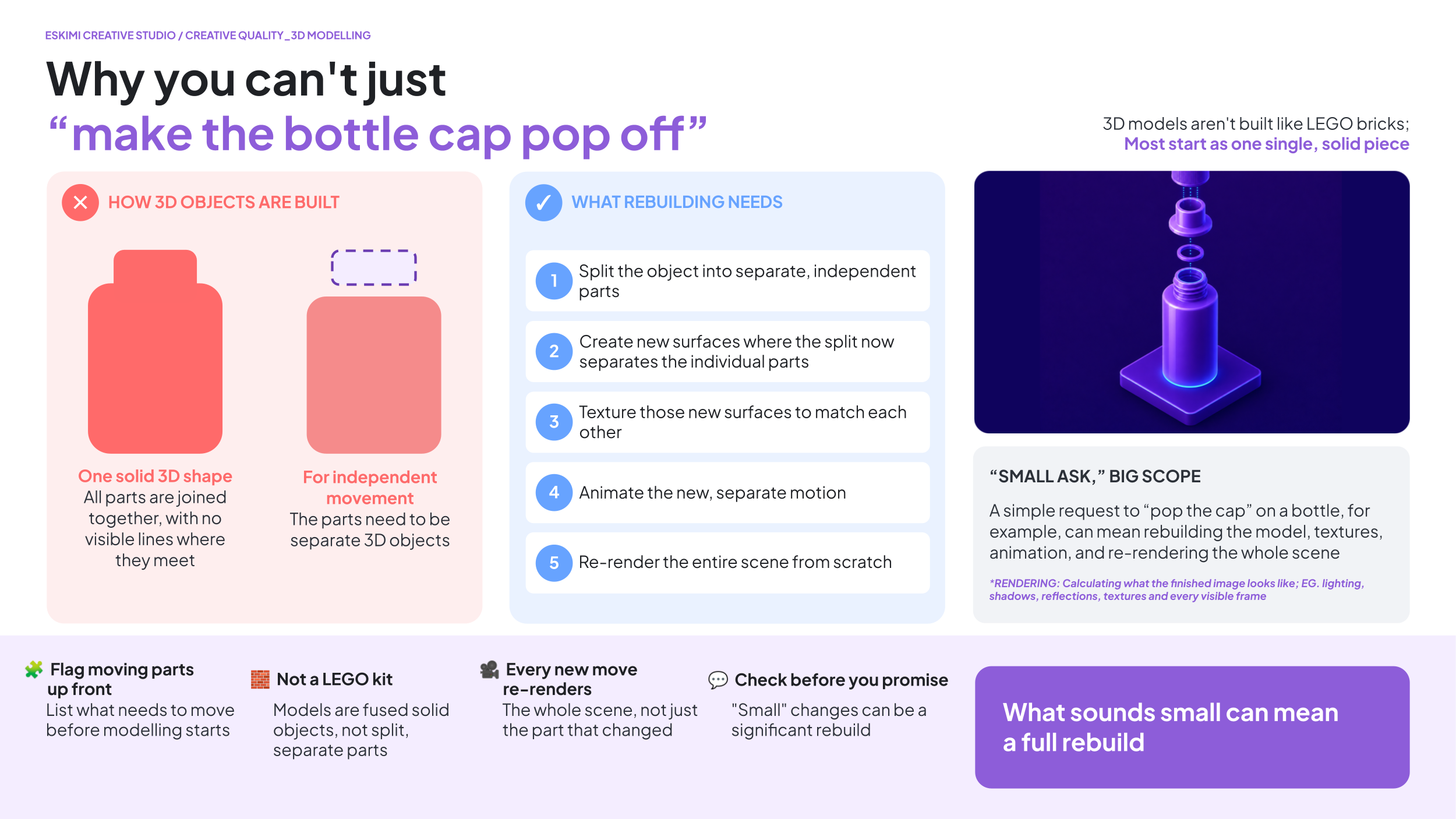
3D models aren't built like LEGO bricks.
Many models are created as a single object. If a client later wants part of that object to move independently (such as a bottle cap opening), we first need to rebuild the model into separate moving parts.
That may involve:
-
Rebuilding the model
-
Creating new surfaces and textures
-
Creating new animations
-
Re-rendering the entire scene
What sounds like a small change can sometimes become a significant rebuild.
🔥 WHY DO MIST, SMOKE, AND FIRE EFFECTS TAKE LONGER?
WHY DO WATER,MIST, SMOKE, FIRE AND OTHERFIRE EFFECTS TAKE SO LONG?LONGER?
🔥 WHY DO MIST, SMOKE, AND FIRE EFFECTS TAKE LONGER?
WHY DO WATER,MIST, SMOKE, FIRE AND OTHERFIRE EFFECTS TAKE SO LONG?LONGER?
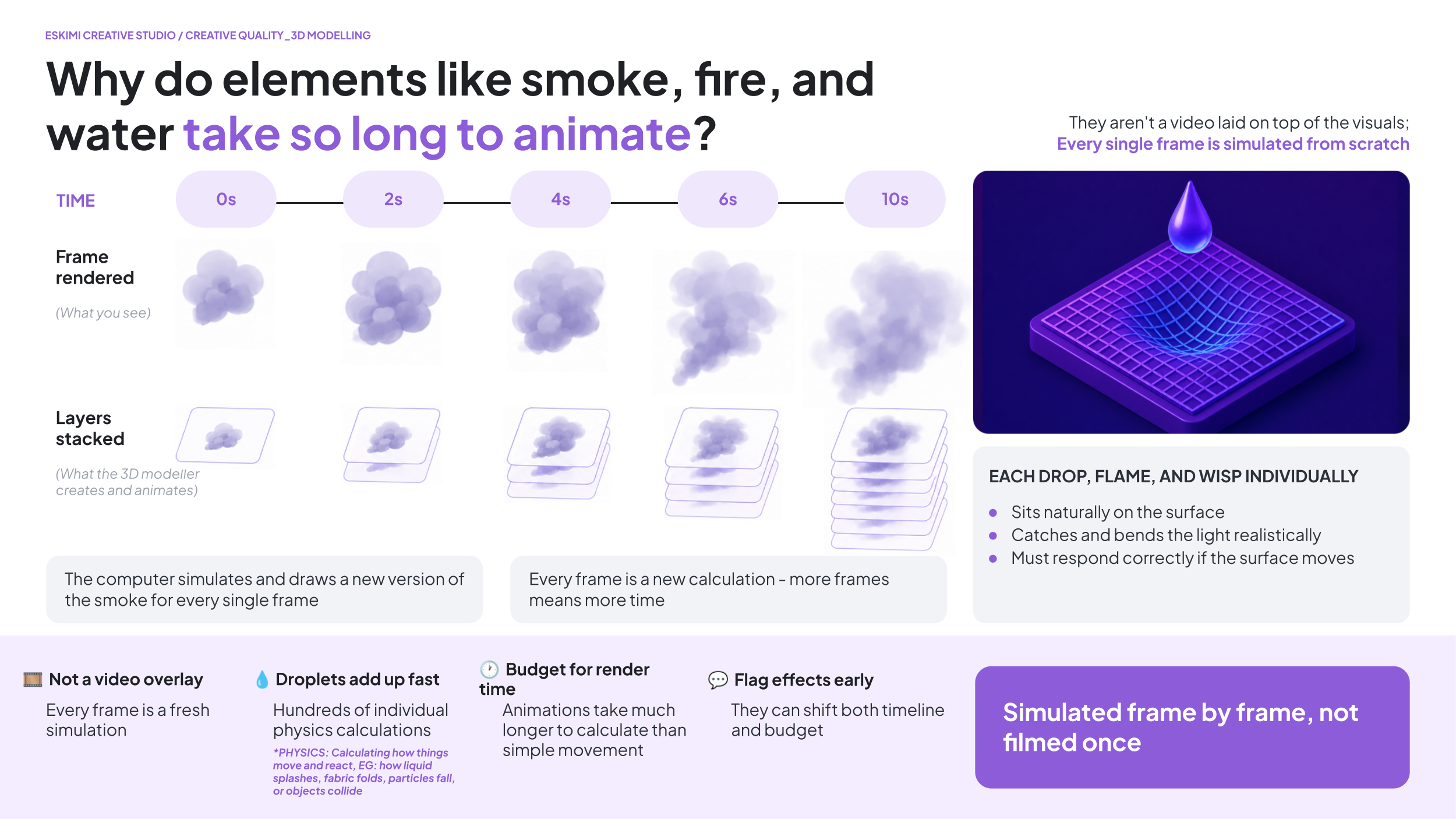
Effects like water, steam, smoke, bubbles, splashes and fire aren't simply videos placed on top of an animation. The computer calculates how these effects move through the scene, frame by frame.
Think of it like drawing a puff of smoke...
...then drawing it again...
...and again...
...for every single frame of a 10-second animation.
That's why these effects require considerably more processing time than simple object animation.
WHY DO WATER DROPS TAKE SO LONG?
A wet bottle isn't just a bottle with dots on it. Each individual droplet has to:
-
Sit naturally on the curved surface
-
Catch the light correctly
-
Reflect its surroundings
-
Look realistic from every viewing angle
-
Move naturally as the object rotate
A single bottle can contain hundreds of droplets, each of which the computer must calculate separately.
🚗 CAN WE CREATE 3D MODELS FOR CAR BRANDS?
CAN WE CREATE 3D MODELS FOR CAR BRANDS?
Theoretically, yes - but automotive 3D modelling can be complex and time consuming.
Cars contain hundreds of precise details, including their body shape, lights, wheels, windows, interior, badges, paint finishes and reflections. For an automotive brand, the vehicle must match the exact model, year, trim and market version. Even a small difference may cause the brand to reject the work.
WHY DOESIS RENDERING TAKEIT SO LONG?CHALLENGING?
-
The model must be completely accurate. Small differences in the headlights, grille, wheels, badges or body shape can make it the wrong vehicle.
-
Every material must look realistic. Paint, glass, chrome, rubber and lights all reflect light differently.
-
The car must look correct from every angle. Problems that are hidden in one view may become obvious when the vehicle rotates.
-
Movement adds more work. Wheels, doors, camera movements, rotating platforms, lighting and background changes must all be set up and tested.
-
Web banners have strict file-size limits. A highly detailed 3D model may be too large or demanding to run smoothly in a browser, especially on mobile devices. It may need to be simplified without changing its appearance.
-
Automotive approval is usually strict. The brand may require several internal, technical and legal approval rounds.
WHERE DOES THE 3D MODEL COME FROM?
FinishingThere are two possible routes:
- The client supplies the
animationofficialdoesn't3Dmeanmodel.it's- This
immediately.isOncetheallbestchangesoptionarebecausecomplete,ittgives us the most accurate starting point. The model should include the correct textures and materials.
ready - This
heWecomputersourcestillanneedsexisting model. We can look for a suitable model online, but:- The exact model or version may not be available.
- The quality may not be good enough.
- Parts or details may be inaccurate.
- The file may be too large for digital advertising.
- Commercial usage rights may need to
calculatebeeverypurchased. - The
ofclient must approve thefinalmodelanimation.before production begins.
frame
ThinkCreating ofan itaccurate likevehicle bakingfrom scratch without an official model would require a cake.specialist Mixing3D artist, detailed reference material and significantly more production time.
WHAT DO WE NEED FROM THE CLIENT?
Before confirming the ingredientsproject, doesn'twe make the cake ready - you still have to bake it. Rendering is that baking stage.
For every frame, the computer calculates:need:
-
LightingThe exact vehicle model, year, trim and market version. -
ShadowsAn official 3D model, if available. -
ReflectionsApproved paint colours, wheel options and product details. -
TransparencyClear reference images from all required angles. -
MaterialsBrand guidelines and rules for showing the vehicle. -
VisualWritteneffectsapproval for any externally sourced model. -
Confirmation of the required movements and camera views.
-
Enough time for modelling, testing, client feedback and corrections.
A shortreference animationvideo mayshows containthe hundredstype of frames, so rendering alone can take several hours.
WHY CAN'T RENDERING BE MADE FASTER?
Rendering is performed byresult the computer,client ratherwants than- it does not provide the artist.3D Onceassets renderingneeded begins,to therecreate computer must calculate every frame individually.
While we always optimise our scenes where possible, rendering time is largely determined by the complexity of the animation and cannot simply be sped up without reducing quality.it.
WHY DOCAN MULTIPLE REVISION ROUNDSIT TAKE SO LONG IN 3D?LONGER?
UnlikeThe awork presentationmay involve sourcing or Photoshopbuilding file,the amodel, correcting its details, applying realistic materials, setting up lighting and movement, rendering or developing the experience, optimising it for the web, testing it across devices and completing several approval rounds.
We should assess every automotive 3D scenerequest isindividually builtbefore asconfirming onefeasibility, completecost environmentor whereturnaround everythingtime. worksThe together.
Changingbecomes onemuch elementfaster oftenand affectsmore manyaffordable others.when Forthe example,client movingsupplies an objectapproved, mayweb-ready also3D require updates to:model.
Camera anglesLightingShadowsReflectionsAnimationsScene composition
Once those changes are complete, the entire animation usually needs to be rendered again before a new preview can be shared.
For this reason, repeated revision rounds can have a significant impact on delivery timelines.
Think of it like building a house. It's much easier to decide where the windows go before the walls are built than to move them after the house is finished.
To keep projects moving efficiently, we ask clients to review versions carefully and provide one consolidated round of feedback wherever possible.
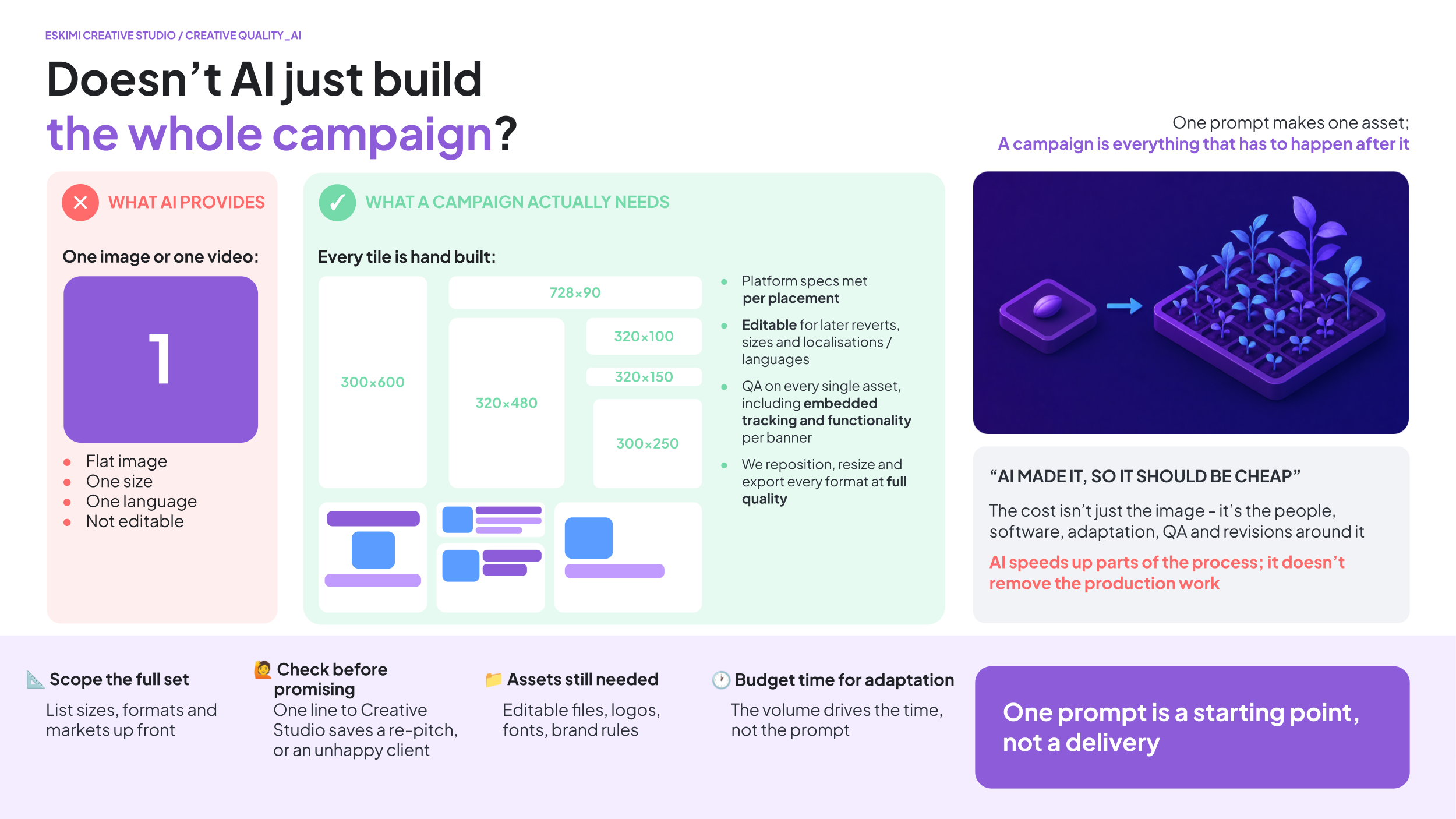
🦾 WHY ARECAN'T AI JUST DO THE 3D PROJECTSWORK MOREFASTER?
EXPENSIVE?
🦾 WHY ARECAN'T AI JUST DO THE 3D PROJECTSWORK MOREFASTER?
3D animation is a specialist craft. Projects often involve:
3D modellingTexturingLightingAnimationVisual effectsRenderingMultiple rounds of testing and quality assurance
Complex animations can take many days to produce, which is why 3D projects typically have higher production costs and minimum media investments than standard banner production.
WHY CAN'T AI JUST DO THE 3D WORK FASTER?
AI is an incredibly useful creative tool, but it isn't yet capable of replacing professional 3D production for most commercial advertising.
While AI can often generate an impressive-looking image or short video, it currently struggles with the things we need for real advertising campaigns, such as:
-
Creating consistent results across multiple scenes
-
Producing editable assets that can be revised later
-
Making changes based on client feedback
-
Recreating the same animation across multiple banner sizes and formats
-
Maintaining accurate branding, products, and fine details
Advertising rarely ends with the first version. Clients often request copy changes, logo updates, different languages, new products, or revised animations. To make those changes, we need editable project files rather than a finished AI-generated video.
Like our cake analogy, think of it like asking AI to bake a cake. It might produce something that looks great in a photo, but if the client later asks for less sugar, a different flavour, or a larger cake, it's much easier if you still have the recipe than if all you have is the finished cake.
AI is already helping us speed up parts of our workflow where appropriate, and we continue to evaluate new tools as they mature. However, for high-quality, editable, production-ready advertising, skilled artists and traditional 3D workflows are still essential.