
Pitching with AI
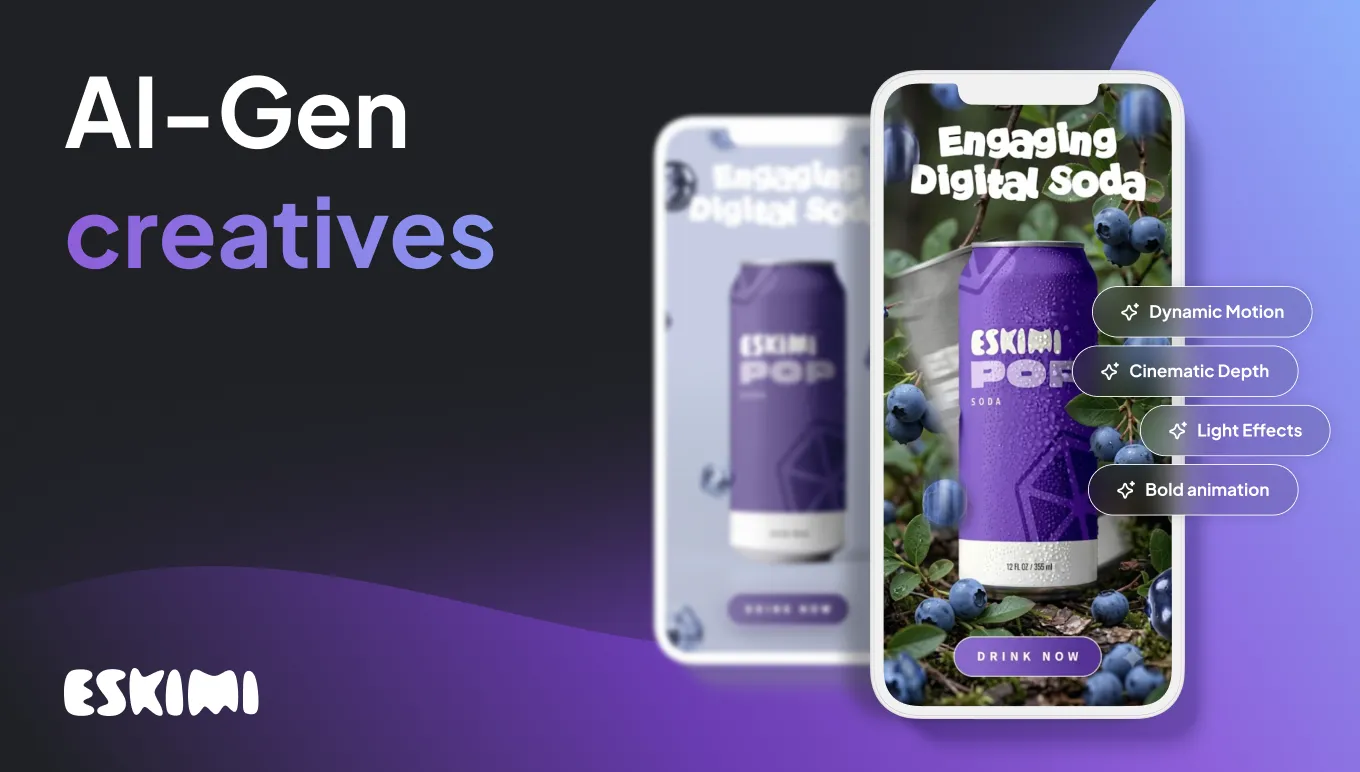
AI BEST PRACTICES: PITCHING
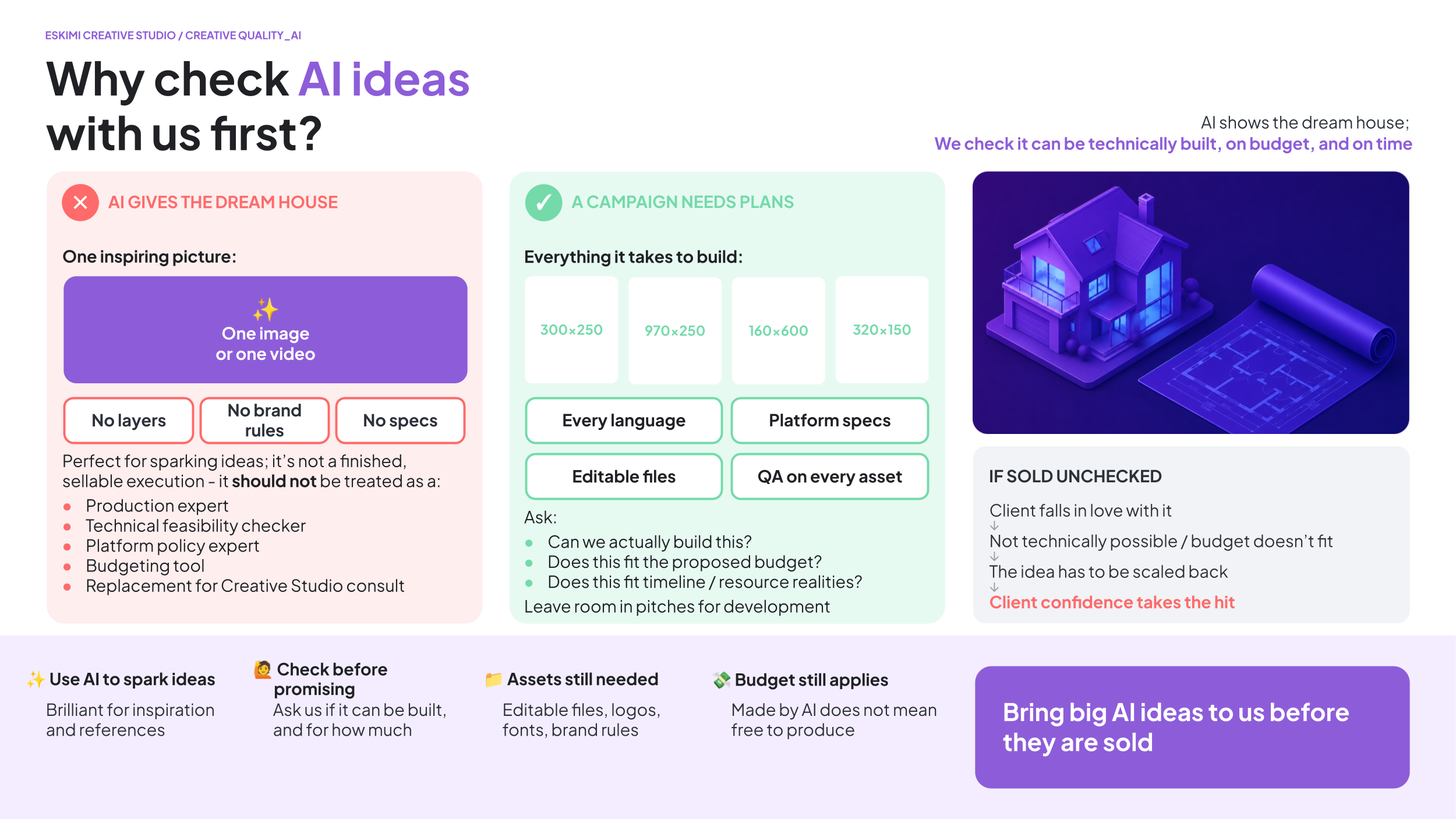
AI-generated creative can be extremely valuable: It can help accelerate ideation, create new visual possibilities, and unlock creative opportunities that were previously difficult or expensive to achieve.
BUT! AI-generated creative still needs to follow the same production realities as any other creative project.
We’re increasingly seeing situations where ambitious AI-generated concepts are being pitched to clients before Creative Studio has confirmed whether:
-
The idea is technically possible
-
It fits within budget
-
Timelines are realistic
✅ AI CAN BE USEFUL FOR
- Generating early-stage inspiration
-
Helping structure thoughts
-
Creating references or jumping-off points
-
Accelerating brainstorming
❌ AI SHOULD NOT BE TREATED AS
- A production expert
-
A technical feasibility checker
-
A platform policy expert
-
A budgeting tool
-
A replacement for Creative Studio consultation
The Creative Studio official mockup tool is coming soon! Watch this space. 👀
*Read our blog post on AI-Gen Creatives here.
BEST PRACTICE
-
Use AI to spark thinking, NOT finalise deliverables
-
Bring ambitious ideas to Creative Studio EARLY
-
Validate feasibility before pitching externally
-
Ask:
-
Can we actually build this?
-
Does this fit the proposed budget?
-
Does this fit timeline / resource realities?
-
- Leave room in client pitches for collaborative development instead of specifying executions too early.
If in doubt, involve Creative Studio early. We’d much rather help shape an idea before it is sold than have to scale it back afterwards. 🙏
Clients do not differentiate between Sales and Creative Studio. To them, we are one team. If we pitch unrealistic concepts, the whole business loses credibility. Going forward, please treat AI-generated concepts as exploratory inspiration - not as production-ready solutions.
Need more detail? Read the explanations below👇
A few important points to keep in mind:
INVOLVE CREATIVE STUDIO BEFORE PROMISING AI TO CLIENTS
What may look simple in an AI-generated video can be extremely complex to recreate in a scalable advertising format.
Or, worst case, the execution you have sold your client might not exist.
Before committing to an execution, please check feasibility with the Creative Studio team so we don’t end up seeming uncooperative when we have to be the bad guys and say it can’t be done. 🥺
A 10-SECOND AI CLIP IS NOT A 10-MINUTE BANNER
AI video tools can turn a prompt into a cinematic sequence in minutes. A fist punches the screen, the glass shatters, steel turns into a bridge, the logo lands. It looks finished, so it feels quick.
It isn't. Every action in that clip is a separate piece of animation our team has to design, build and time, and then make work across every banner size within file-size limits. A mockup that took two minutes to generate can take days to produce properly.
We're increasingly receiving requests that are short films, not banners. When that lands on a same-day deadline, something has to give, and it's usually quality, the timeline, or both.
✅ WHAT A GOOD AI-INSPIRED REQUEST LOOKS LIKE
- One clear idea you can describe in a sentence
- One main animated moment (EG. the "50 Years" text pops out in 3D)
- The AI image or clip attached as mood reference, not as the spec
- A timeline that matches the complexity
❌ WHAT CAUSES DELAYS
- Chains of actions (A happens, which causes B, which transforms into C)
- New actions added after work has started ("can the fist also smash the screen?")
- Complex ideas sold to the client on an urgent deadline
- AI visuals shown to the client before the Studio has confirmed we can build them
KNOW WHICH LEVEL YOU'RE ASKING FOR
- Simple: logo reveal, text animation, CTA, product entrance - standard turnaround
- Enhanced: 2-3 animated elements and one transition - allow extra time
- Motion sequence: multiple actions, transformations, effects (anything that looks like an AI video clip) - treated as custom production: needs a storyboard sign-off, the matching budget tier, and extra time
If you're not sure which level your idea falls into, ask us before you pitch it.
URGENT = SIMPLE
If the deadline is tight, pitch the simple version. A clean, well-built simple idea wins more often than an ambitious one delivered late or half-finished. If the client likes it, we can build the bigger version once the campaign is confirmed and there is time and budget for it.
PITCH OR PRODUCTION? SUBMIT IT IN THE RIGHT PLACE
- Pitch mockup (client hasn't confirmed): submit as a token request; one concept, one revision round
- Won campaign: submit a production request with budget, assets and deadline; this is where the full build happens
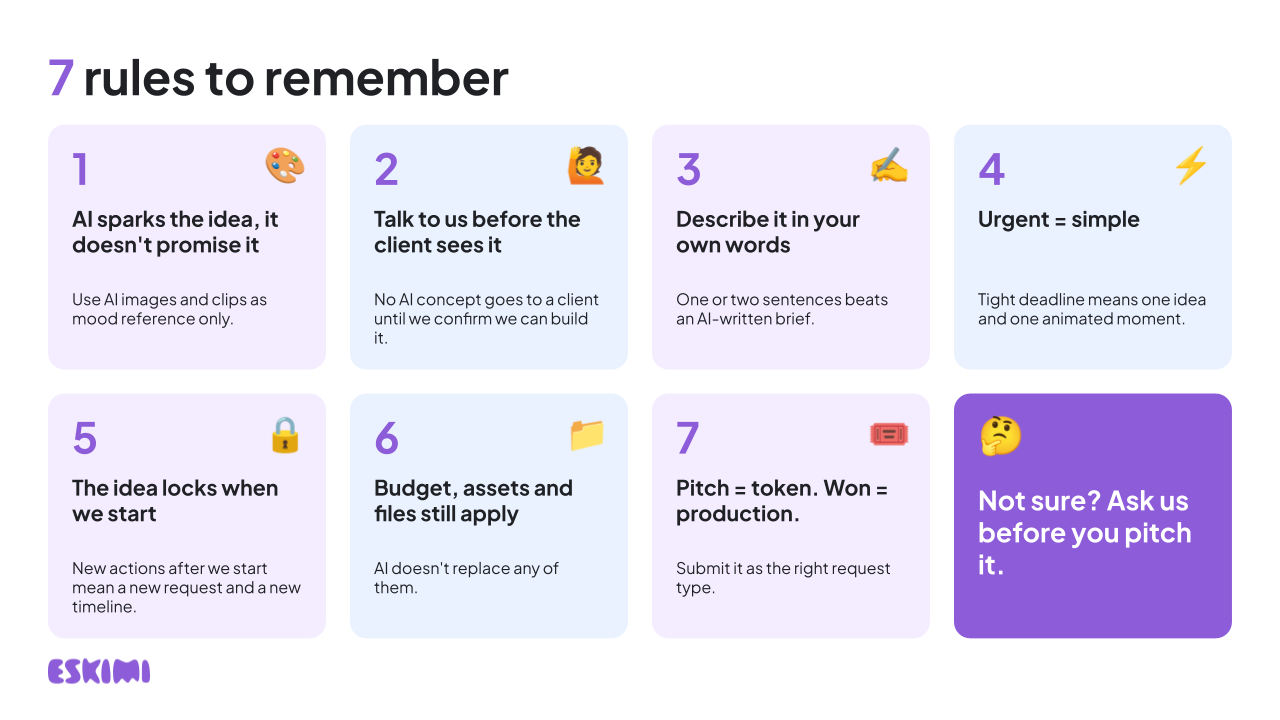
AI is a great way to show us what's in your head. It is not a quote, a timeline or a promise to the client. Talk to the Studio before the client sees it, and we'll help you pitch something we can actually deliver on time.
✏️ HOW TO BRIEF IN AI
HOW TO BRIEF IN AI
💸 REVENUE RISK
Even with the best intentions, we can accidentally cause more harm than good for our clients. If we have to tell a client that a concept that they loved, it:
-
Damages client confidence
-
Makes us look disorganised internally
-
Positions Creative Studio as “the bad guy”
-
Creates unnecessary back-and-forth and delays
-
Weakens confidence in our capabilities
-
Risks overpromising and underdelivering
-
Wastes time for all stakeholders
-
Worst case: you lose your pitch, and blame Creative Studio
🧭 GIVE US THE DIRECTION, NOT A PRODUCTION SCRIPT
AI can quickly turn a simple idea into a detailed, scene-by-scene creative brief. The result may sound impressive, but it can include effects, interactions or game mechanics that have not been checked by Creative Studio.
Every specific effect you put in front of a client (“sparks here”, “liquid there,” etc) can become a promise.
If the final execution works differently, then it’s too much, too little, not what the client pictured - they may feel that something is missing or become disappointed. This can lead to confusion, additional revisions and slower delivery.
💡 Give us the general creative direction and examples. Leave the detailed flow and technical execution to Creative Studio to bring to life.
WHAT CAN YOUR BRIEF INCLUDE?
- The main campaign idea
- The campaign objective
- The desired mood or visual style
- What you want the audience to understand or do
- Important products, messages or assets to include
- Examples or references the client likes
- Any confirmed client requirements
WHAT SHOULD CREATIVE STUDIO DEVELOP?
Leave the following to our designers and developers:
- The scene-by-scene sequence
- Exact animation effects
- Detailed user interactions
- Game steps and mechanics
- Transitions between screens
- Technical behaviour
- How the concept adapts across banner sizes
- Alternative solutions if an element cannot work as imagined
Creative Studio understands how the idea must work inside the advertising unit, what is technically possible and how the execution can be adjusted when the client requests changes. That’s the part we’re here for.💪
A few clear and honest lines about the idea are more useful than two pages of AI-generated instructions.
Creative Studio is happy to help shape and strengthen ideas early in the process. Strong collaboration before the pitch creates better outcomes for everyone:
-
Better client trust
-
Smoother production
-
Fewer delays
-
Stronger work
-
A better reputation
OPEN FILES ARE STILL NECESSARY
If a client wants an AI-generated concept, we still need the same production assets as any other project, including:
-
Editable PSD / PSB / AI files
-
Logos
-
Product assets
-
Fonts
-
Brand guidelines
-
Any other relevant source materials
AI outputs alone are rarely sufficient to build a production-ready campaign.
AI DOESN’T KNOW THE CLIENT’S BRAND RULES
AI tools are not familiar with client:
-
Brand guidelines
-
Legal requirements
-
Regulatory restrictions, etc
Generated outputs should always be reviewed rather than assumed to be correct.
AI DOESN’T AUTOMATICALLY MAKE MULTIPLE ASSETS
One AI-generated video is not the same as a complete campaign.
We still need to:
-
Build multiple banner sizes
-
Create different formats and placements
-
Adapt for multiple markets and languages
-
Ensure assets can be edited and updated later
-
Meet platform specifications
People often think AI generates an entire campaign with one prompt. In reality, AI usually creates one image or one video. We still need to:
-
Build every required banner size
-
Adapt layouts for different aspect ratios
-
Replace text for different languages
-
Meet each platform's technical specifications
-
QA every asset before delivery
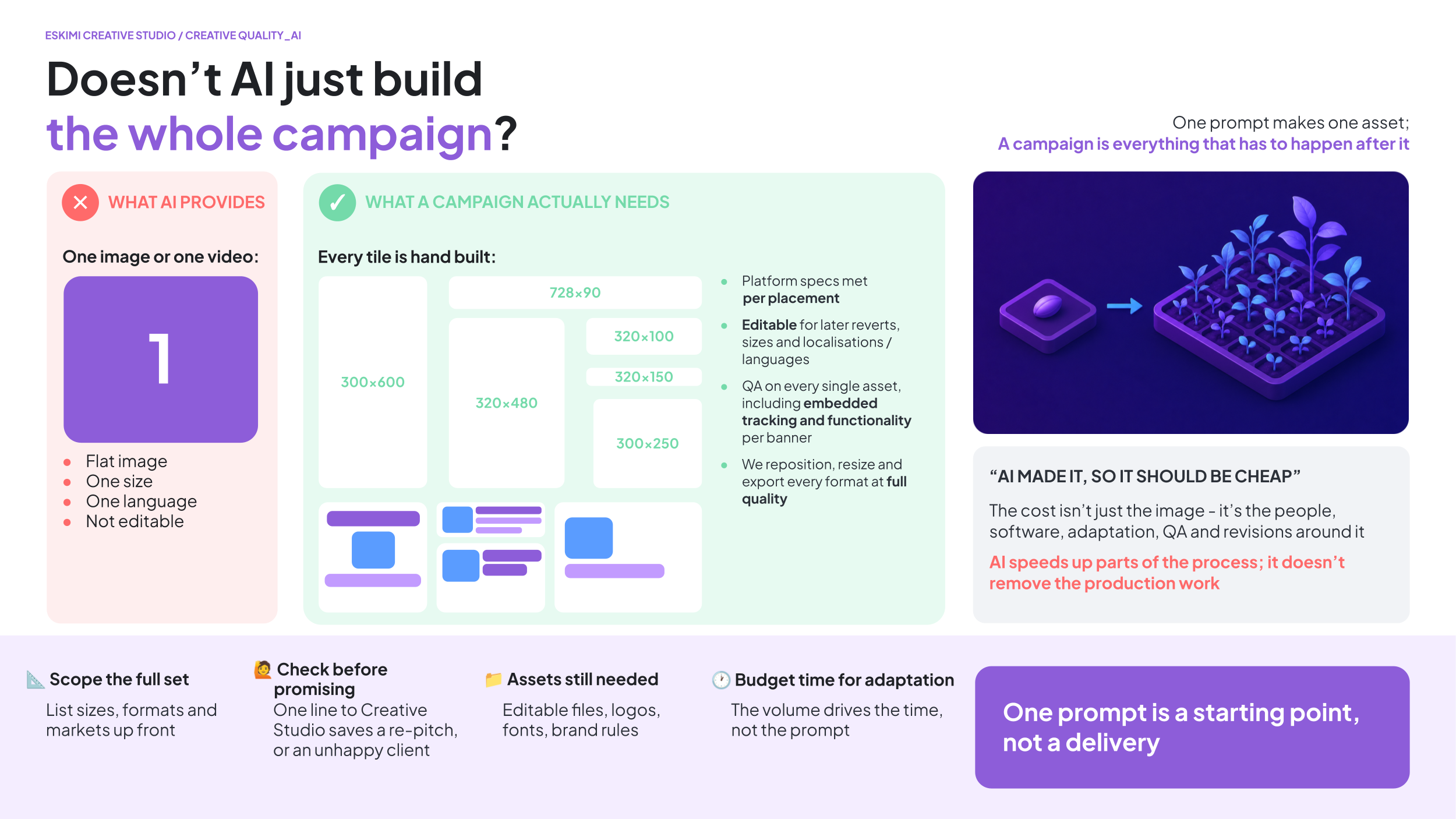
AI speeds up parts of the process; it doesn't remove the production work.
BUDGET STILL MATTERS
Another common misconception is that “the AI made it, therefore it should be cheap.”
We still invest in people, software, infrastructure, quality control, revisions, project management, and creative expertise to bring campaigns to life.
Remember that minimum spend requirements are there to ensure production costs are covered by sales margins.
🙅 LIMITS OF AI
WHY WE CAN’T USE AI TO RECREATE REAL PEOPLE
Using AI to recreate a real person does not remove the need to obtain the appropriate rights and permissions.
There are typically two separate legal considerations:
-
Copyright: the rights associated with the original photograph or artwork
-
Personality (or publicity) rights: the rights associated with a person's name, image, likeness, or identity
Generating images of real public figures using AI does not remove the legal or commercial licensing requirements.
COPYRIGHT
When we purchase a stock photograph, we're paying for the copyright licence to use that specific image.
-
If we instead generate an AI image, we may avoid licensing the photograph itself, but we're still creating a commercial advertisement featuring the recognisable likeness of real people without permission to do so
-
For commercial advertising, this may still require permission from the individual or their authorised representatives
PERSONALITY (OR PUBLICITY) RIGHTS
Many public figures - particularly athletes, actors, musicians, and influencers - have commercial agreements governing how their likeness may be used in advertising.
-
These rights exist independently of the copyright in any particular photograph
-
Using AI does not automatically bypass them
-
Many sponsorship agreements give brands exclusive rights to use an athlete in advertising within certain product categories
AI should not be considered a replacement for obtaining the necessary commercial rights. Using AI-generated images of real individuals in advertising could still expose the campaign to legal or contractual issues if the advertiser does not have the appropriate rights to use those peoples’ likenesses.
For that reason, we cannot assume that "just using AI" is a compliant alternative to licensing photography.
Where a campaign features a recognisable real person, the safest approach is for the client to provide assets that they have the legal right to use, such as:
-
Officially licensed promotional assets
-
Photographs with the appropriate commercial usage rights
-
Written confirmation that the required image and publicity rights have been secured
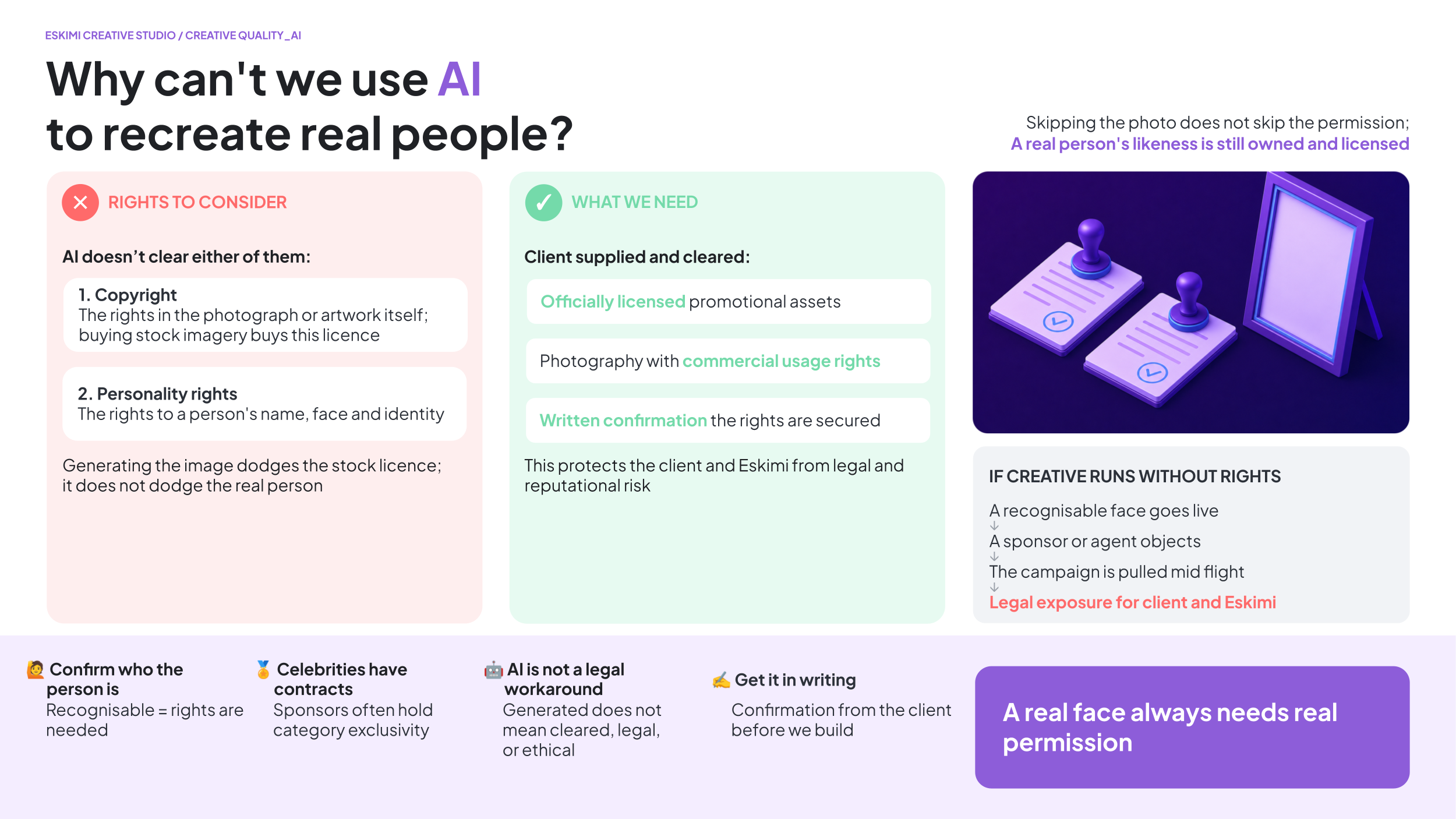
This helps protect both the client and Eskimi from potential legal, contractual, and reputational risks.
WHY WE CAN'T USE AI OR 3D TO RECREATE COPYRIGHTED CHARACTERS
Using AI or 3D modelling to recreate well-known fictional characters does not remove the need to obtain the appropriate intellectual property rights.
Many famous characters - such as those from Disney, Pixar, Marvel, DC, Nintendo, Pokémon, Minions, The Simpsons, and other films, TV shows, games, or comics - are protected by copyright and trademark law. Even apparel like Nike Air Jordans are extremely restrictive about this.
Whether the character (or even logo) is:
-
AI-generated
-
3D modelled from scratch
-
Illustrated
-
Animated
-
or manually recreated
…the underlying intellectual property still belongs to the rights holder.
Creating "something that looks like" a protected character for commercial advertising may still infringe those rights, even if no existing artwork was copied.
For this reason, AI and 3D modelling should not be considered a way to bypass licensing requirements.
If a campaign requires the use of a recognisable fictional character, the client should provide:
-
Officially licensed artwork or models
-
Written confirmation that they have the necessary commercial rights
-
Brand guidelines or usage instructions where applicable
This helps protect both the client and Eskimi from potential legal, contractual, and reputational risks.