
Impression Capping vs Frequency
Impression capping and frequency are often mixed up. Impression capping is a setting that limits how often one user can see a campaign. Frequency is a result that shows how often users actually saw it. This page explains both and how they work together.
Impression Capping
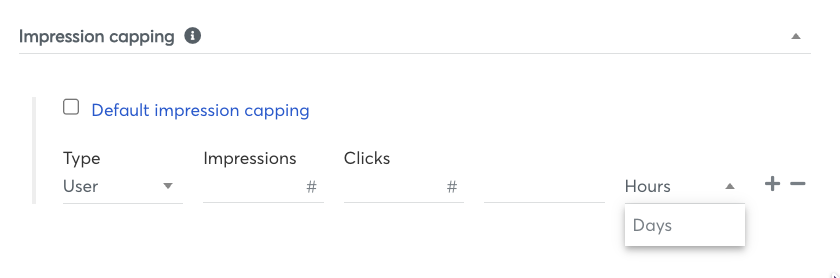
Impression capping sets the maximum number of impressions and clicks that a campaign can serve to the same user, or on the same site or app, within a time period. You set it in the campaign's Impression capping section:
-
Type: User limits how many impressions the same user can see; App/Site limits how many impressions can be served on the same site or app in the time period.
-
Impressions: the maximum number of impressions.
-
Clicks: the maximum number of clicks.
-
Time period: a number of Hours or Days.
Tick Default impression capping to use the default, or click + to add more rules. Rules can be combined, for example a limit per day and another per 7 days.
When a user reaches the limit, the campaign stops bidding on that user until the period ends. In reporting, this shows as the "impression capping" filtering reason.
Default: 7 impressions and 1 click per user per 24 hours. Adjust it to fit the campaign goal.
Impression capping sets the maximum, not a target. The DSP can reach one user more times than another, so the campaign's frequency will differ from the cap and is usually lower.
Frequency
Frequency is the average number of times each reached user saw the ad:
Frequency = impressions ÷ reach (unique users)
Example: capping is 7 impressions per 24 hours. One user sees the ad once, another twice and another 7 times. That is 10 impressions for 3 users, so the frequency is 3.33.
A frequency goal on a campaign is the planned average frequency. The DSP does not optimise towards it, so use it to compare actual frequency with the plan. Reach is an estimate, so even with a cap of 1 impression per user, reach and impressions can differ slightly (see Reach Calculation on Eskimi DSP).
How They Differ
|
|
Impression capping |
Frequency |
|---|---|---|
|
What it is |
A setting |
A result |
|
What it describes |
The maximum impressions per user in a period |
The average impressions per reached user |
|
When it applies |
Set before launch, applied while the campaign runs |
Measured during and after the campaign |
|
Where to find it |
Campaign settings |
Reporting (impressions ÷ reach) |
Capping sets the ceiling for frequency, but it does not decide the average. A cap of 7 per day does not mean users will see the ad 7 times: many will see it only once or twice.
Impression capping is also not the same as user bid capping, which stops the DSP from bidding on the same user several times in one second. See Multiple Bids per User per Second.
Summary
Impression capping is the limit you set; frequency is what you get. Use capping to stop the same users from seeing the ad too often, and use frequency to check how often they actually saw it.
If a campaign underspends and the filtering reasons show impression capping, loosening the cap gives it more chances to deliver. Expect frequency to rise when you do.